Where Your Downspout Water Actually Goes
A well-built gutter with nowhere good to send its water is only half a system.
September 16, 2026 · 3 min read
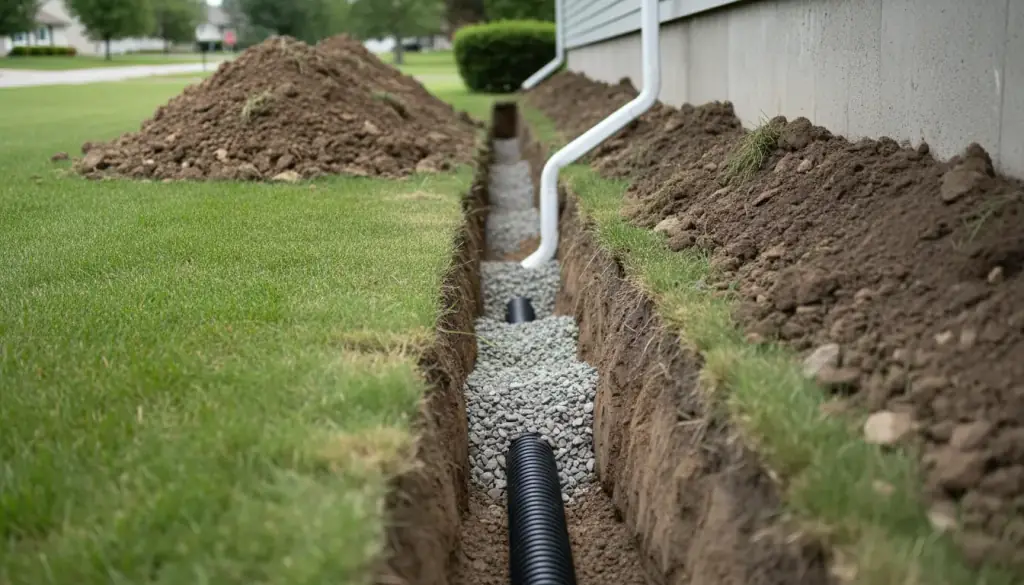
Here's a scenario that trips up a lot of homeowners: new seamless gutters, properly pitched, outlets sized right, and the basement still gets damp every time it rains hard. The gutter did exactly what it was supposed to do. It moved a large volume of roof water down to one specific point at the foundation, fast, all at once. What happens in the last two feet after that is a completely separate problem, and it's the one that actually decides whether you stay dry.
A downspout that dumps at the wall just relocates the water
A splash block or a short extension that ends a foot or two from the foundation isn't moving the water away, it's just setting it down closer to the wall than the roof was. On Sangamon County's heavy clay soils, water doesn't soak in quickly the way it would in sandy ground. It sits, spreads sideways along the surface, and finds the path of least resistance, which is very often straight down along the foundation wall to the footing.
Why central Illinois clay makes this worse than it looks
Clay swells when it's wet and shrinks when it dries, and that movement is exactly what opens hairline cracks in a foundation wall over time. A downspout that's been discharging at the same spot for years, season after season, is training the soil right there to hold water against the wall longer than the soil six feet away. Sandy soil would let that same volume of water soak straight down and disperse. Sangamon County clay does the opposite: it seals up on the surface almost like a bowl, so the water has nowhere to go but sideways, toward whatever is lowest, which is usually the foundation wall itself.
It's a slow problem, which is why it's easy to ignore right up until the basement actually starts taking on water during a heavy storm. Nobody notices a downspout doing this in year one. By year five or six, that one corner of the yard has usually developed its own drainage habits, a slightly sunken track where the water runs, sometimes a bit of settling in the soil right at the discharge point, and none of it looks urgent until the wall behind it finally lets water through.
What a buried drainage line actually changes
Drainage tile takes that same downspout water and carries it somewhere that isn't six inches from your foundation. The line gets trenched and pitched away from the house, sized to the volume the downspouts feeding it are actually putting out, and run out to daylight or another suitable outlet, below the frost line so it isn't sitting exposed to freeze and crack over a central Illinois winter. It's not a fix for the gutter. It's the piece that finishes the job the gutter started, and a house can have flawless seamless gutters upstairs and still have a wet basement if this piece was never installed or has silted shut.
Reading your own yard after a storm
- A working line shows water moving or already gone at its outlet an hour or so after heavy rain, not standing in a puddle
- Grass growing unusually green or lush in a straight line across the yard often traces a buried line that's leaking, not draining
- A soggy spot that reappears in the same place near the foundation after every storm is the exact signature of a downspout with nowhere real to send its water
A line that's already there can still fail
Not every wet basement means there's no drainage line at all. Older tile, especially clay tile from decades back, silts up over time as fine soil works its way in through the joints, and a line that used to run clear can slow to a trickle without anyone digging it up to check. If a house has always had good drainage and it's only recently started acting up after storms, a silted or partially collapsed line is at least as likely a cause as one that was never installed in the first place.
If you've got a Springfield or Auburn basement that stays dry most of the year and only acts up after real rain, the gutter probably isn't your problem. It's what happens after the downspout. Springfield Gutters can walk your yard, trace where the water's actually going right now, and tell you straight whether a drainage line will fix it. Call (217) 698-4357.
Springfield Gutters, (217) 698-4357
Call (217) 698-4357More articles
The Clean Gutter That Overflows Anyway
An empty-looking trough and a flooded flowerbed are not a contradiction once you know where gutters actually fail.
What a Springfield Fall Does to an Open Gutter
Central Illinois autumn doesn't ease a gutter into trouble, it fills one in a matter of weeks.