What a Springfield Fall Does to an Open Gutter
Central Illinois autumn doesn't ease a gutter into trouble, it fills one in a matter of weeks.
September 16, 2026 · 3 min read
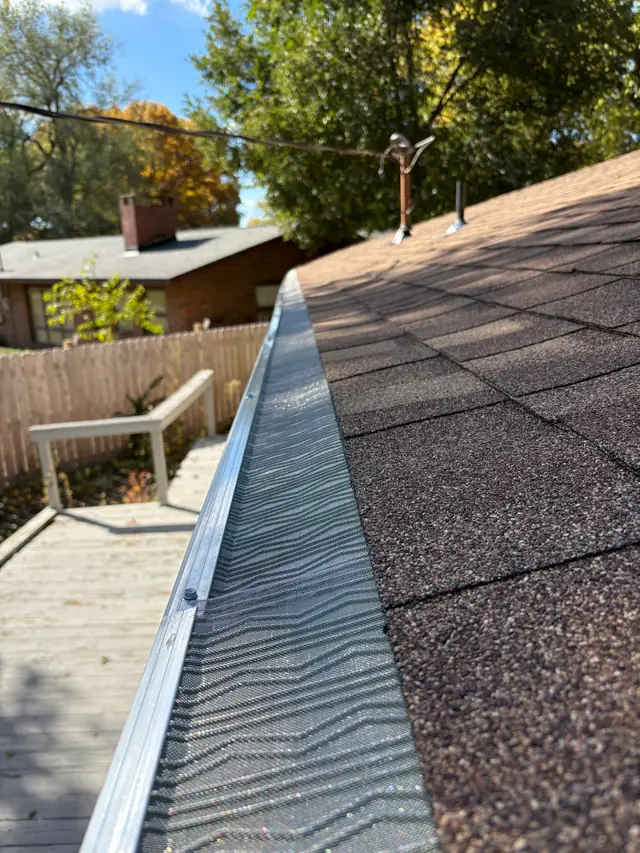
Walk any older neighborhood in Springfield in late October and you'll see it: a gutter that was empty at Labor Day, packed solid by Halloween. It isn't one big leaf fall. It's maple keys spinning down first, then sweetgum balls, then the actual leaves on top, all landing in the same six-inch trough over about six weeks. An open gutter doesn't fail gradually in the fall. It fills fast, and then it freezes.
Why it happens so much faster than summer buildup
In summer, whatever grit or pollen collects in a gutter mostly washes through with the rain. In fall, the material coming down is bigger, drier, and it locks together. Maple keys wedge against each other at the outlet. Sweetgum balls, with their spiky shells, catch on hidden hangers and on each other instead of sliding through. Once that first layer catches, everything behind it stacks up on top, and a trough that handled every summer storm fine starts overflowing at the first real fall rain.
Then it freezes, and the weight problem starts
A full gutter that goes into a hard freeze is carrying weight the hangers were never sized for. Wet leaf mat alone is heavy. Frozen solid, with water trapped inside it turning to ice, that same mat can weigh several times what an empty gutter run is built to hold, spread unevenly along whatever stretch happened to fill first. Central Illinois gets that freeze-thaw cycle repeatedly through the winter, not once and done, and a gutter loaded with wet, frozen leaf mat pulls at spike-and-ferrule hangers with every single cycle.
That's a big part of why so many gutters you see sagging or pulling away from the fascia trace back to a fall that nobody cleared. The damage doesn't show up in November. It shows up in February or March, once the ground has thawed enough for someone to notice a gutter hanging a half inch lower than it used to, and by then the hangers have already been working loose for months.
What leaf protection actually solves
A mesh guard fitted to the roof pitch and shingle profile keeps the big material out. Maple keys and sweetgum balls slide off the surface instead of dropping into the trough, and that alone removes the fast-fill problem that defines a Springfield fall. Fewer ladder trips, no more racing a cold front to get the leaves out before the first freeze, and a gutter that's still doing its job in December instead of holding a solid mat of frozen debris.
What it doesn't solve, and why that's fine
Guard mesh isn't a promise of never cleaning again, and anyone who tells you that is overselling it. Fine grit still comes off the shingles and settles on top of the mesh over a couple of seasons. Pollen in spring forms a thin film across it. Neither of those causes the overflow and freeze-weight problems that loose leaves do, but the guard surface itself is worth a look once in a while so it keeps shedding water the way it's supposed to instead of holding a slow buildup of its own.
It's worth being honest about that upfront, because the guard that gets sold as a one-time, never-touch-it-again fix is the one homeowners end up disappointed by two years later. The realistic promise is fewer cleanings, not none, and no more racing the calendar every October to get up there before the first hard freeze locks whatever's already fallen into place.
Deciding if it's worth it for your house
- How many mature maples, sweetgums or oaks actually overhang your roofline, not just stand somewhere in the yard
- How many times a year you're currently clearing gutters by hand, and what that adds up to over a few years
- Whether your fascia already shows staining or softness from past overflow, which points at a run that's been losing this fight for a while
For a lot of Springfield, Chatham and Rochester properties with real tree cover, the guard ends up costing less over a few years than the cleanings it replaces, on top of taking the November ladder trip off the calendar entirely. Springfield Gutters can look at your specific trees and roofline and tell you honestly whether it's worth it for your house. Call (217) 698-4357 before the leaves start coming down this year.
Springfield Gutters, (217) 698-4357
Call (217) 698-4357More articles
The Clean Gutter That Overflows Anyway
An empty-looking trough and a flooded flowerbed are not a contradiction once you know where gutters actually fail.
Where Your Downspout Water Actually Goes
A well-built gutter with nowhere good to send its water is only half a system.