Reading Your Fascia Board From the Ground
You don't need a ladder to spot a gutter that's been failing for a while. The board underneath already told on it.
September 16, 2026 · 3 min read
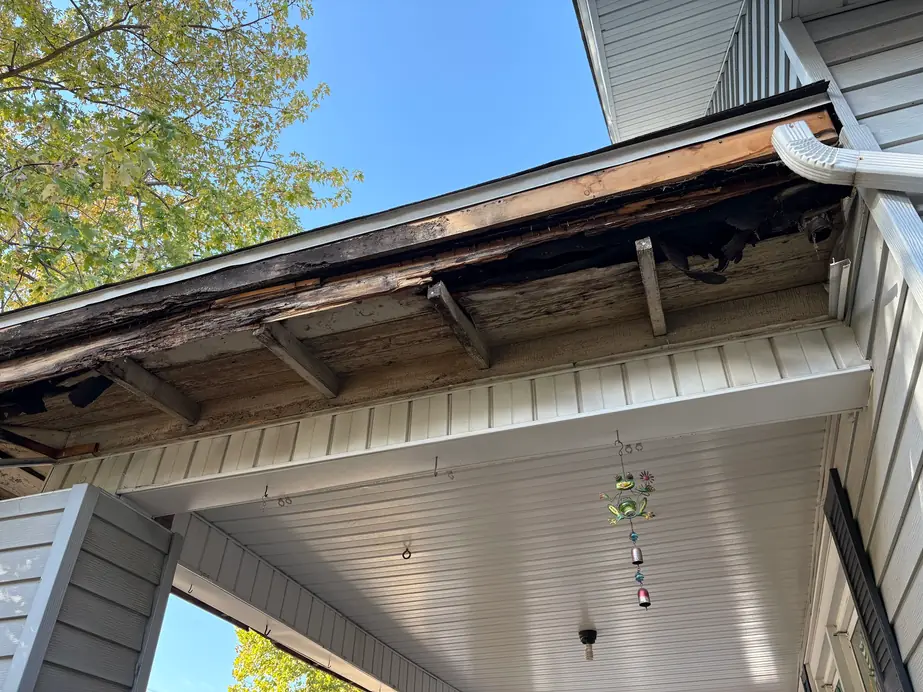
Stand back from your house on a bright day, far enough to see the whole roofline at once, and look at the board the gutter is actually hung on. Most people never look there. They notice a gutter is failing when water is already coming over the front edge in front of them, which means the board behind it has usually been taking damage for a season or two already. The fascia keeps a record, and you can read most of it from the lawn.
Peeling paint in a long straight line
Paint that's cracking or peeling in a straight strip right along the gutter, and nowhere else on the same wall, is a moisture pattern, not a paint-quality problem. That line is exactly where an overflowing or back-pitched gutter has been running water down the face of the board instead of through the downspout. If the rest of your trim is holding paint fine and just that one strip is failing, the gutter above it is telling you something.
Dark streaks that don't wash off
A dark stain running down the fascia from a single point, especially right below a joint in a sectional gutter, usually marks where water has been finding a way out that isn't the outlet. Sectional gutters have a seam every ten feet or so, and those seams are exactly where a weeping leak shows up first. A seamless run, formed in one piece for the length of the roofline, doesn't have that mid-span seam to weep from in the first place.
A soft or spongy board
This one you can sometimes catch from the ground too: a section of fascia that looks slightly warped, wavy, or darker than the wood around it, especially near a downspout or a corner. Wood that's held water for a while stops holding its shape, and paint sitting on soft wood tends to bubble rather than crack cleanly. If you can press a fingertip against it from a ladder and feel give, it's already gone past the point of drying out on its own, and it's usually further along than it looks from a distance.
Binoculars from the yard will tell you more than you'd think. Look for a slight wave in the line of the fascia where it should run dead straight, or a spot where the paint color has gone a shade darker than the boards on either side. Both are early tells, well before a board gets soft enough to feel by hand.
A gutter that's visibly sagging or pulling away
Hidden hangers are only as strong as the wood they're driven into. Once fascia has softened, the fasteners have nothing solid left to grip, and a run starts to sag between hanger points or pull slightly away from the wall along its length. That's not a cosmetic issue you can leave for later. A sagging run collects water in the low spots it creates, which speeds up exactly the rot that caused the sag.
Why the board has to come first
Hanging a new gutter on fascia that's already soft is spending money twice. The new hangers go into the same compromised wood, the run can't be pitched properly onto a board that's warped, and the whole problem repeats within a season or two, usually faster the second time because the wood behind it started this round already weakened. The rotten sections need to come out and get replaced with sound board before the gutter goes back up, not covered over and hoped past. It also protects the part you can't see from the ground: soffit ventilation has to stay clear behind that new board, or moisture just gets trapped in the attic space instead of on the fascia.
None of these signs mean the whole roofline needs new fascia. Most of the time it's one section, right below one weak joint or one downspout that's been backing up, and the rest of the board is perfectly sound. The point of learning to read it from the ground isn't to diagnose the whole job yourself. It's to catch the problem while it's still one section, before a whole winter of freeze and thaw turns it into several.
If you've spotted any of these signs on your own house, in Springfield or out toward Rochester or Sherman, it's worth a look before the next hard freeze does more damage to the wood underneath. Call Springfield Gutters at (217) 698-4357 and describe what you're seeing. A lot of the time it can be sorted out over the phone which service you actually need.
Springfield Gutters, (217) 698-4357
Call (217) 698-4357More articles
The Clean Gutter That Overflows Anyway
An empty-looking trough and a flooded flowerbed are not a contradiction once you know where gutters actually fail.
What a Springfield Fall Does to an Open Gutter
Central Illinois autumn doesn't ease a gutter into trouble, it fills one in a matter of weeks.